

Watch any movie from the 1970s, 1980s, or early 1990s and you will soon see how much our world—and we—have changed. Before the digital era, we watched long opening credits with nothing but text on them, sat through endless explication, and were willing to track meandering plots. Directors trusted audiences to pay attention and follow the story.
Not so much any more.
With so many things competing for our attention on social media, texts, emails, fitness apps, Google, AI, and 24-hour news cycles—to name but a few of the distractions held within the magic boxes we call our cell phones—movies now start with conflicts, explosions, and chases even before the first credits roll. Their plots jump from one thrilling moment to another. And it’s not just movies, of course. Articles have gotten shorter and are so often reduced to a single scare quote before being shared with friends. Complex political debates have devolved into name-calling and meaningless labels and slogans.
One sometimes wonders how a contemplative craft like poetry might survive.
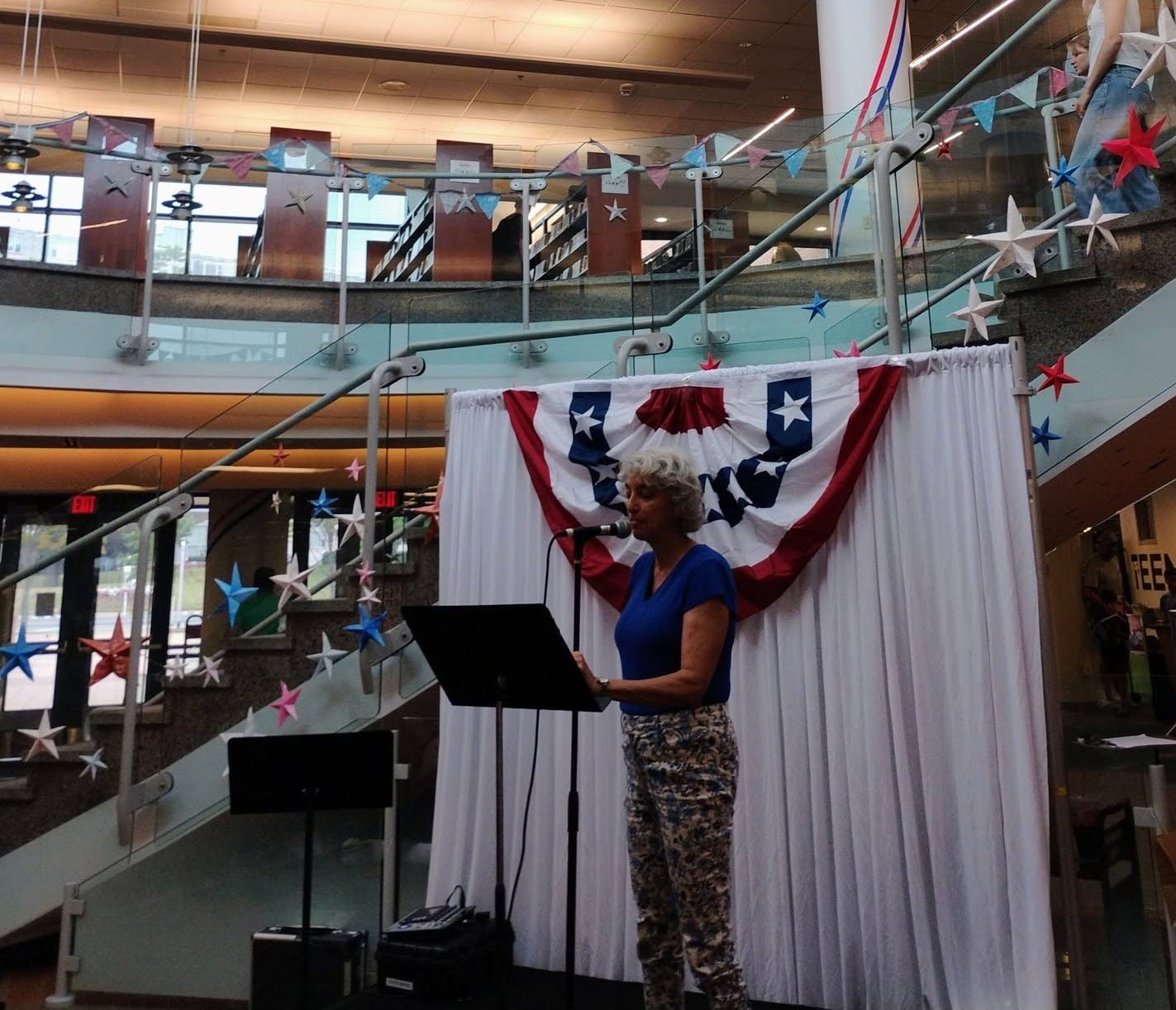
Poetry of course requires slowing down and agreeing to consider life’s small moments and big questions with an author. This past weekend, I got to see if poetry could compete with the noise of life in a very literal way. I was honored to be invited to read at Arlington County’s LibraryFest, designed to recognize the 250th anniversary of our nation’s founding.
I was worried attendance would be down because of the very scary air-quality alerts caused by smoke from the Canadian wildfires, but that did not seem to stop people at all. The library had moved all the planned activities inside as part of a rainy-day plan that also doubled as a code-red-air-day plan. When I checked in, the place was abuzz with children and their parents, yuppies, couples, senior citizens, people in colonial-era costumes, and festival-goers and library patrons of all stripes.
I learned that the Spoken Word stage was going to be in the open first-floor atrium of the library. While grateful for the visibility the spot provided—it was smack in the middle of the space, right in front of the main entrance doors, and it was nice to see poetry not being shunted off to some out-of-the-way meeting room on the third level—I was a little nervous at the prospect of trying to command attention in a setting that was more akin to a state fair than a staid poetry reading. My fears were not assuaged when I sat down to listen to the readers scheduled before me; they seemed unused to working with a microphone and could not really be heard over the surrounding pandemonium.
When it was my turn, I simply adjusted the mic stand to be two feet taller and used my booming teacher voice, which certainly comes in handy from time to time, to check if the audience could hear me. They could, they said! I then used my 15-minute slot to read four of my poems, all of which dealt with different facets of American life.
Something strange happened. People who had been chatting in the seats quieted. Others joined the audience to listen until all the seats were taken. They were not fidgeting. They were not looking at their phones. They were not rifling through their LibraryFest programs. Their faces seemed genuinely engaged with my words.
After I was done, several people came up to me to share how the poems had moved them and reminded them of their own experiences. Somehow, amid the kids making tri-cornered hats out of paper and friends and neighbors greeting each other and the Uncle Sam character wandering around and the popcorn machine operating loudly down the hall and regular library patrons trying to get books checked out, we had created a space for thinking, for appreciating language, and for considering life’s questions together.
Even in today’s noisy, harried world, poetry still has the power to captivate, and that is why I still bother to write it: to create the magical hush of “the best words in the best order,” as Coleridge advised us back in 1827.
Maybe there is hope for us yet.
Insightful – and I’m glad your teacher’s voice got their attention.